 listicle
What to Ask Moving Companies: 15 Questions to Know
Table of Contents
- Why the Right Questions Protect Your Move
- Questions to Ask Moving Companies About Licensing and Insurance
- Moving Estimate Types: Binding, Non-Binding, and What They Mean
- Questions to Ask About Moving Insurance and Valuation Coverage
- Moving Company Contract Checklist: What to Read Before You Sign
- Moving Company Red Flags: Questions That Reveal a Bad Hire
- How to Ask About Services, Crews, and Subcontracting
- Conclusion
- Frequently Asked Questions
Last Updated: September 20, 2026
Why the Right Questions Protect Your Move
Knowing what to ask moving companies before you sign anything is the difference between a smooth relocation and a costly dispute. This guide from Taylor Moving LLC breaks down the 15 questions that matter most, from licensing checks to contract fine print.
Questions to Ask Moving Companies About Licensing and Insurance
Licensing and insurance questions come first because everything else depends on them. A mover without proper registration or coverage has no legal obligation to make you whole if something breaks.
Verify the USDOT Number and FMCSA Registration
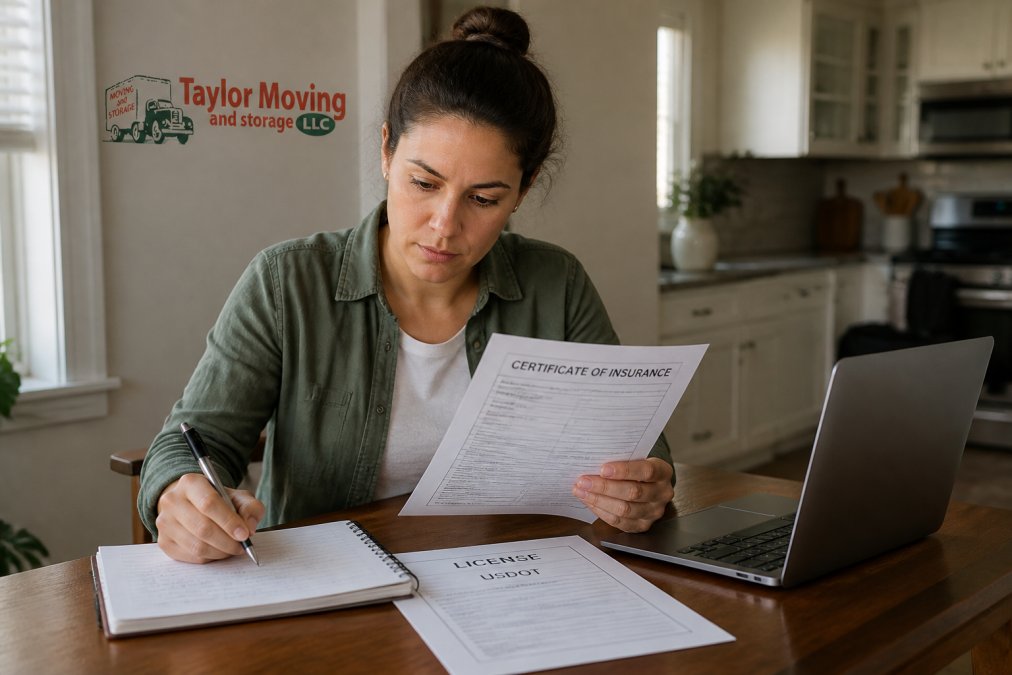
Ask for the company's USDOT number and look it up in the FMCSA's public database before you go further. Interstate carriers must be registered, and the record shows their operating authority and complaint history. If a company hesitates or gives you a number that doesn't match its business name, that's your answer.
Workers Compensation and Cargo Insurance
Workers compensation insurance covers a mover injured on your property. Without it, you could face liability if someone gets hurt carrying your piano down the stairs. Ask for a certificate of insurance and confirm the policy is current.
Moving Estimate Types: Binding, Non-Binding, and What They Mean
There are three main moving estimate types, and understanding the difference prevents surprise charges on delivery day. Ask which type you're being offered, in writing.
| Estimate Type | Price Certainty | Best For | Watch Out For |
|---|---|---|---|
| Binding | Locked if inventory matches | Fixed budgets | Charges for added items |
| Non-binding | Final cost varies | Uncertain inventories | Bill higher than quote |
| Binding not-to-exceed | Capped maximum | Most residential moves | Ceiling still based on weight |
In-Home Survey vs. Virtual Walkthrough
An in-home survey means a representative walks through your home, counts items, and notes access issues like stairs or narrow doorways. A virtual walkthrough does the same over video. Both beat a phone-only quote.
Accessorial Charges and Additional Fees to Ask About
Accessorial charges are fees beyond basic transport. Ask specifically about:
- Stair carries and long carries (distance from door to vehicle)
- Shuttle services if a large truck can't reach your street
- Packing materials and labor
- Appliance disconnection and reconnection
- Storage-in-transit if your new home isn't ready
Get every potential fee in writing before you book.
Questions to Ask About Moving Insurance and Valuation Coverage
Valuation coverage is not the same as insurance, and confusing the two is one of the most expensive mistakes in moving. Ask directly: "What valuation options do you offer, and what does each cover?"
Full Value Protection vs. Released Value Protection
Full value protection means the mover is liable for the replacement value of lost or damaged items, subject to the contract terms. Released value protection is the basic, no-extra-cost option, and it typically pays a small amount per pound per item. A 10-pound item at that rate might reimburse you a few dollars.
How Damage Claims and Dispute Resolution Work
Ask how to file a damage claim, what the deadline is, and who handles disputes. Federal rules require interstate carriers to have a claims process, but timelines and documentation requirements vary. Get the process in writing before the truck arrives.
Moving Company Contract Checklist: What to Read Before You Sign
The moving contract is where promises either hold up or fall apart. Read it before you sign, not on moving day when the truck is loaded. Federal rules require interstate carriers to give you a written estimate and a copy of the contract terms before you commit, and to provide the booklet Your Rights and Responsibilities When You Move.
Bill of Lading, Inventory List, and Delivery Window
The bill of lading is your contract and receipt. It lists the agreed services, the estimate type, and the terms. The inventory list documents every item and its condition at pickup. The delivery window states when your goods should arrive.
- Company's legal name, USDOT number, and physical address
- Your name, pickup address, and delivery address
- Pickup date and the delivery spread (the range of dates, not a single guess)
- Estimate type (binding, non-binding, or binding-not-to-exceed) and the amount
- Valuation coverage level you selected and its cost
- Payment terms, including what's due at pickup versus delivery
- The mover's process for handling loss or damage claims
Digital Contract Red Flags and Cancellation Policy
Digital contracts are convenient, but they hide problems well. Watch for:
- Blank delivery windows or "to be determined" dates
- Clauses allowing the mover to subcontract without notice
- Fees that appear only in the fine print
- No clear cancellation policy or refund terms
- Mandatory binding arbitration clauses that strip your right to sue
- Automatic renewal or storage-extension language that converts a move into a storage contract
- A signature line that references a different entity than the one you vetted
Rescheduling, Delays, and Force Majeure
Ask what happens if your closing date slips or the truck is delayed. A legitimate contract states a delivery spread and explains how the mover communicates changes. Look for a force majeure clause, it excuses the mover for events outside its control, but a broad one can excuse almost anything.
Post-Move Communication Protocol
Most guides stop at delivery. Ask these before you sign, because they determine how discrepancies get resolved after the truck leaves:
- Who is my single point of contact after delivery?
- What's the deadline to report missing or damaged items, and in what format?
- How do you handle inventory discrepancies discovered after the crew departs?
- Will I get a written acknowledgment of my claim, and within how many days?
Moving Company Red Flags: Questions That Reveal a Bad Hire
Certain answers expose a bad mover before you commit. Ask these and listen carefully.
- "Can you provide three customer references from the past six months?" A legitimate company will share them.
- "Will the crew that loads my items be the same crew that delivers them?" Vague answers suggest subcontracting.
- "What's your process if my delivery window slips?" Silence or deflection is a warning.
- "Can I see your FMCSA record and complaint history?" Refusal is disqualifying.
How to Ask About Services, Crews, and Subcontracting
Service questions reveal whether a company can actually handle your move or will hand it off. Ask what's included, who shows up, and who's accountable.
Packing Services, Specialty Items, and Storage-in-Transit
Ask whether packing services are included or billed separately, and how they handle specialty items like pianos, artwork, or antiques. If your closing dates don't align, ask about storage-in-transit, which holds your belongings between pickup and delivery. Confirm whether storage is climate-controlled, whether your goods stay in the mover's facility or a third-party warehouse, and how access works if you need something mid-storage.
Subcontracting Transparency
Many companies broker moves to other carriers or hire day laborers. Ask directly: "Will the crew that loads my items be the same crew that delivers them, and are they your employees or subcontractors?" A legitimate company answers without hesitation. Vague answers, "we work with partners," "it depends on the route", mean your belongings may change hands multiple times, and accountability gets murky when something breaks.
If the company uses subcontractors, ask:
- Who is legally responsible if my items are damaged?
- Will I be notified in writing before my move is handed off?
- Is the subcontractor licensed and insured to the same standard?
- Does the subcontractor carry its own workers compensation coverage?
Background Checks and Crew Accountability
Ask whether crews are employees or subcontractors, and whether the company runs background checks on everyone who enters your home. A mover who can't answer clearly about who's showing up is a risk you don't need to take. Ask specifically:
- Are background checks run on every crew member, including day labor?
- Are crews uniformed and do they carry photo identification?
- Who is the on-site supervisor, and how do I reach them during the move?
Equipment and Fleet Maintenance
Few movers get asked about their trucks, but the condition of the fleet affects the safety of your belongings. Ask:
- How old is the fleet, and how often are trucks serviced?
- Do trucks have air-ride suspension and working lift gates?
- Are moving blankets, straps, and dollies in good condition?
- Is the truck climate-controlled for electronics, artwork, or antiques?
Conclusion
Asking the right questions takes an afternoon, but it protects thousands of dollars in belongings and a lot of stress. Start with licensing and insurance, confirm the estimate type in writing, and read every contract clause before you sign.
Frequently Asked Questions
What are the biggest red flags when hiring a moving company?
Watch for a company that demands a large cash deposit before the move, refuses to provide a USDOT number, or gives a quote without seeing your home or inventory. Other warning signs include no written contract, pressure to sign on the spot, and a price that changes once the truck is loaded. Ask for the bill of lading and read the cancellation policy before you commit. A legitimate mover will answer every question in writing.
How do I verify a moving company is properly licensed and insured?
Ask for the company's USDOT number and check it on the FMCSA website. For moves within a state, confirm the carrier holds the required state registration. Request a certificate of insurance showing both cargo insurance and workers compensation coverage. A licensed and insured mover will share these documents without hesitation. If a company cannot produce them, walk away before you sign anything.
Should I ask for an in-home estimate or a virtual quote?
An in-home survey gives the most accurate estimate because the estimator sees your inventory, stairwells, and parking access. A virtual walkthrough works well for smaller moves or when timing is tight, but it may miss details that affect accessorial charges. Either way, ask whether the estimate is binding or non-binding. A binding estimate locks the price; a non-binding estimate can change based on actual weight and services.
What should a moving company contract include?
Your contract should include the bill of lading, a detailed inventory list, the pickup and delivery window, the total estimated cost, and the valuation coverage you selected. Ask about the cancellation policy and any accessorial charges for stairs, long carries, or specialty items. Read the fine print on damage claims and dispute resolution. Never sign a blank or incomplete contract, and keep a copy for your records.
What is the standard policy for filing a claim if items are damaged?
Report damage in writing as soon as you notice it, ideally before the crew leaves. Most carriers require claims within a set window, often nine months for interstate moves under federal rules. Include photos, the inventory list, and the bill of lading with your claim. Ask upfront how the company handles disputes if your claim is denied. Full value protection covers more than released value protection, so confirm which applies to your move.